تماس فوری
Getting to know impact press: the beating heart of metal products
Introduction
What is impact press?
The main components of the device
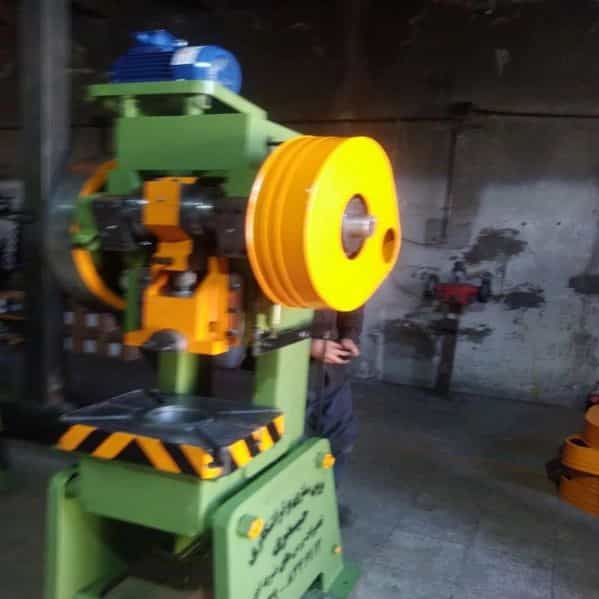
- Body (frame): The main structure of the device, which has the task of bearing the heavy forces. (Heidari press bodies are usually made of cast iron or strong alloy steel).
- Crank or eccentric: The moving part that converts the rotation of the motor into vertical movement.
- Ram (Ram): The part to which the mandrel is attached and directly impacts the part.
- Press table: The place on which the lower mold or matrix
- Clutch and brake: have the task of connecting and disconnecting power transmission and immediately stopping the movement of the ram in emergency situations.
work process
- Feeding: The metal sheet enters the space between the mandrel and the matrix by the operator or automatic feeder.
- Strike: By pressing the pedal or button, the clutch is engaged and the ram moves down.
- Shaping: The mandrel hits the sheet with pressure and drives it into the matrix cavity to create the desired shape (cut, bend, or stretch).
- Return: RAM returns to top dead center and the segment is ready to be unloaded.
Industrial applications
- Automotive industries: for the production of body parts, chassis and interior parts.
- Production of household appliances: manufacture of refrigerators, washing machines and small internal parts.
- Electronics industries: manufacture of connectors and small enclosures.
- Production of fittings and tools: manufacture of washers, screws and iron parts small.
Safety tips (very important)
- Using a light curtain: to prevent the operator's hand from touching the danger zone.
- Two-hand protection systems: which forces the operator to put both hands on the buttons to prevent the hand from entering the press area.
- Periodical service: Checking the clutch, brake and regular lubrication of moving parts to prevent accidents caused by failure. mechanical.
conclusion
First part: structure and mechanism of impact press
- Body (Frame/C-Frame):
- The main body of the device, which has the task of bearing the stresses and forces resulting from the impact. In Heydari presses and similar models, gray cast iron or high-strength welded steel is used to minimize vibrations during operation.
- Power transmission system (Drive Train):
- Ram (Ram / Slide):
- The part to which the mandrel (Punch) is connected and by moving straight down, performs the shaping operation. The accuracy of RAM movement is very critical in the quality of the final product.
- Clutch & Brake system:
- The function of this section is the controlled connection of power to the crank and the immediate stop of the ram at the desired time or in emergency cases.
- Press table (Bolster Plate):
- Fixed surface on which the lower mold (Die) is mounted. It must be completely level and strong to withstand blows well.
Part II: Impact press applications
- Cutting & Piercing:
- Using cutting dies to separate parts from sheet metal or create holes with high precision and speed.
- Bending:
- Changing the angle of the sheet to make parts such as corners, studs or bodies of electrical devices.
- Deep drawing Drawing):
- Converting flat sheets into hollow containers (such as sinks, pots, or cylindrical bodies) by applying gradual pressure.
- Coining & Embossing:
- Applying extreme pressure to engrave a design or symbol on a metal surface that requires precision in detail.
- Forming (Forming):
- Creating complex three-dimensional shapes on the sheet, which is very common in the automotive industry (such as engine doors or fenders).
Key tips to improve your technical knowledge
- Difference in tonnage: Always remember that impact presses are classified based on "tonnage" or "pressure capacity" (for example, a 40 ton, 60 ton, or 100 ton press). Choosing the right stroke length determines the depth of the part you want to produce.
- The importance of lubrication: In heavy presses such as Heydari presses, the automatic lubrication system increases the life of the machine by several years to prevent the friction of the crankshaft and bearings.
1. The role of providing deformation force (driving force)
- The impact press must produce a force (tonnage) that overcomes the yield stress of the metal so that the metal sheet leaves the elastic (spring) state and enters the plastic state (permanent deformation).
- This device, by storing energy in the "Flywheel" and releasing it at the moment the mandrel hits the sheet, creates an instant and powerful impact, which is necessary for cutting or forming thick sheets.
2. Determining role in "repeatability" and dimensional accuracy
- Course stability: The impact press is responsible for guiding the mandrel to a specific depth with millimeter precision. If the press has play in the guides or the crank, the production parts will suffer "tolerance" and the production waste will increase.
- Hardness of the body: The role of the press here is to absorb vibrations and reaction forces. High-quality presses (such as Heydari's engineered samples) with their rigid bodies prevent the device from changing its shape during impact and guarantee the dimensional accuracy of the part.
3. The role of time management and production rhythm (scheduling)
- Number of strokes per minute (SPM): The speed of the press determines how many pieces can be produced per hour.
- Synchronization: In automatic lines, the press must be able to perfectly synchronize with peripheral systems (such as feeders or part-moving robots). The role of the press here is to send a signal to the peripheral systems to determine when the sheet has entered the mold and when the part should be removed.
4. Role in mold protection
- Clutch and brake systems: The press must be able to stop in a fraction of a second if the slightest error occurs (for example, the previous part is stuck in the mold). If the press performs poorly in impact control, expensive molds will break in the first impact.
- Height adjustment (Shut Height): The press has the role of adjusting the working space of the mold so that it does not cause premature wear by pressing too much on the bottom of the mold.
Technical summary for use in the article:
- "The impact press, as the main unit of power generation and geometric control in the pressing process, has the task of transferring the mechanical energy necessary to change the plastic shape of the sheet to the mold while maintaining the dimensional accuracy and exact time rhythm, and at the same time, by optimally managing the impact, it ensures the useful life of the tool (mold)."
A study on the application of impact press in the metal parts production industry
abstract
1. Introduction
2. Structural analysis and mechanism
- Kinetic energy: The electric motor transfers energy to the flywheel. The flywheel stores energy and discharges it at the moment the mandrel hits the sheet to provide the necessary force for cutting or forming.
- Repeatability: Unlike hydraulic presses, impact presses have a fixed course. This feature allows the mandrel to reach an exact depth on each stroke, which is critical to maintaining quality in mass production.
3. Fields of industrial application
- Automotive industry: Production of body parts (mudguards, doors), chassis structural parts and fasteners.
- Household appliance industries: Production of cylindrical bodies for washing machines, gas stove parts and refrigerator compartments.
- Electronics industry: Manufacture of connectors, switches and metal frames of small parts.
- Production Fittings and connectors: production of screws, washers and industrial rivets.
4. Economic and production benefits
- High production rate: The possibility of making hundreds of blows per minute, which greatly increases the speed of the production line.
- Reduction of waste: With the correct design of the mold and the use of presses with low slack, the sheet waste is minimized.
- Tool life: Although the design of the initial mold costs money, but in mass production, the cost per piece using an impact press is lower than others. The methods are much less.
5. Technical considerations and maintenance (service and safety)
- Operator safety: Due to the high speed, the installation of protective equipment such as light curtains and two-hand control systems is mandatory to prevent work accidents.
- Preventive maintenance: Lubrication of the crank system and periodic inspection of the clutch and brake to prevent loss of accuracy and costly breakdowns are an integral part of the management of pressing workshops. is.